How-to
How to get lawn stripes with a cordless mower
Published
Note: This page contains affiliate links. If you buy through them we may earn a commission at no extra cost to you. Learn more
In short
Lawn stripes come from bending the grass in alternate directions, usually with a rear roller. Mow straight parallel lines, turning at each end so every other strip runs the opposite way, and keep the grass a little longer so the blades bend visibly. Without a roller, stripes are fainter, but a striping attachment can help.
Products for this job
Compare all 6 productsGreenworks 24V 33 cm: 8 kg, brushless
Check price on AmazonAffiliate linkYard Force 40V 37 cm: rear roller for stripes
Check price on AmazonAffiliate linkHusqvarna Aspire LC34: folds, hangs on a wall
Check price on AmazonAffiliate link
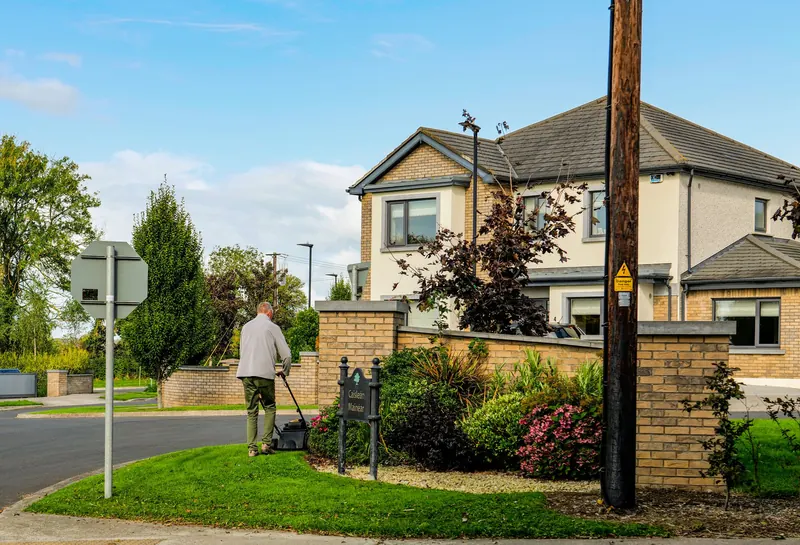
Stripes are not painted or cut in. They are light reflecting off grass blades bent in different directions. Grass bent away from you reflects more light and looks paler; grass bent towards you looks darker. A roller on the back of the mower presses the blades down in the direction you walk, so alternating your direction on each pass creates the pattern. Here is how to get clean stripes with a cordless mower, and what to try if yours has no roller.
Why stripes appear
Each grass blade has a flat face that reflects light. When a roller bends a strip of grass away from where you stand, you see the broader, shiny faces, so the strip looks light. Turn round and look the other way and the same strip looks dark. That is why stripes seem to swap colour when you walk to the other end of the lawn.
Longer grass bends more visibly than very short grass, so stripes show better at a moderate cutting height. A dense, healthy lawn also stripes better than a thin, patchy one.
What you need
The simplest route is a mower with a rear roller. Several cordless mowers in our guides have one: the Yard Force 40 V 37 cm is listed with a rear roller for striped patterns, and the Hayter Harrier 48 AD has a two-piece ribbed rear roller and self drive for larger lawns. Cylinder mowers almost always have a roller too.
If your mower has wheels at the back and no roller, you can still get faint stripes from the wheels and the deck, or fit a striping kit where the maker offers one for your model.
- A mower with a full width rear roller, or a striping kit.
- A sharp blade, so the grass is cut cleanly rather than torn.
- Dry grass, as wet grass smears and clumps.
- A cutting height a little above your usual minimum.
Step by step: mowing stripes
Plan your stripes along the longest straight line in the garden, often parallel to the house, a path or a fence. That edge becomes your guide for the first pass.
- 1
Set the cutting height one or two notches higher than your shortest setting.
- 2
Mow a strip all the way round the edge of the lawn first. This gives you room to turn.
- 3
Start the first stripe along a straight edge, walking at a steady pace and looking ahead at a fixed point.
- 4
At the end, turn on the edge strip and come back the opposite way, overlapping the first stripe slightly.
- 5
Repeat until the lawn is done, keeping each pass straight and the overlap even.
- 6
Finish with one more pass round the edge to tidy the turning marks.
Cutting height and lawn care for better stripes
Stripes need grass long enough to bend. The RHS suggests around 25 to 40 mm in summer for an everyday family lawn, a little higher in spring, autumn, dry spells and shade. Stay within the one-third rule and do not remove more than a third of the height in one cut; our one-third rule tool shows how low to go.
Mow when the grass is dry, keep the blade sharp, and change the direction of your stripes every few weeks, for example lengthways one week and crossways the next. That stops the grass leaning permanently one way and reduces wear lines from the wheels.
| Pattern | How to mow it |
|---|---|
| Straight stripes | Parallel passes, alternate direction each pass |
| Chequerboard | Stripe one way, then repeat at right angles |
| Diagonal | Stripe at 45 degrees to the house or path |
If your mower has no roller
Without a roller you will see some striping from the wheels and the airflow under the deck, especially on longer grass, but the contrast is weaker. Some makers sell striping kits or rollers that fit particular models; check the maker's accessories and manual rather than fitting something not designed for your mower.
If stripes matter to you, choosing a mower with a roller is the reliable answer. Our small garden cordless mower guide and large garden cordless mower guide note which models have one.
Note:Remove the battery or safety key before you touch the blade, clear the deck or tip the mower, and wait for the blade to stop completely. Wear sturdy gloves, as the blade edge stays sharp. Never tip or lift a running mower. Charge batteries only with the maker's charger, away from heat, and stop using any pack that is swollen, cracked or very hot. If in doubt, ask a dealer or service agent.
Frequently asked questions
Do I need a roller to get lawn stripes? A roller gives the clearest stripes. Without one you can get faint stripes, especially on longer grass.
Why are my stripes faint? The grass may be too short, wet or thin, or the mower may have no roller. Raise the cutting height a notch and mow dry grass.
Can a robot mower make stripes? Most robot mowers cut in random or systematic patterns without a roller, so they do not create traditional stripes.
How often should I change stripe direction? Every few weeks, so the grass does not lean one way permanently and wheel marks do not wear lines into the lawn.
What you need
- Check price on AmazonAffiliate link
Greenworks 24V 33 cm: 8 kg, brushless
- Check price on AmazonAffiliate link
Makita DLM462PT4: 46 cm, four 5 Ah batteries
- Check price on AmazonAffiliate link
Greenworks 48V 41 cm: 440 m², two 4 Ah batteries